
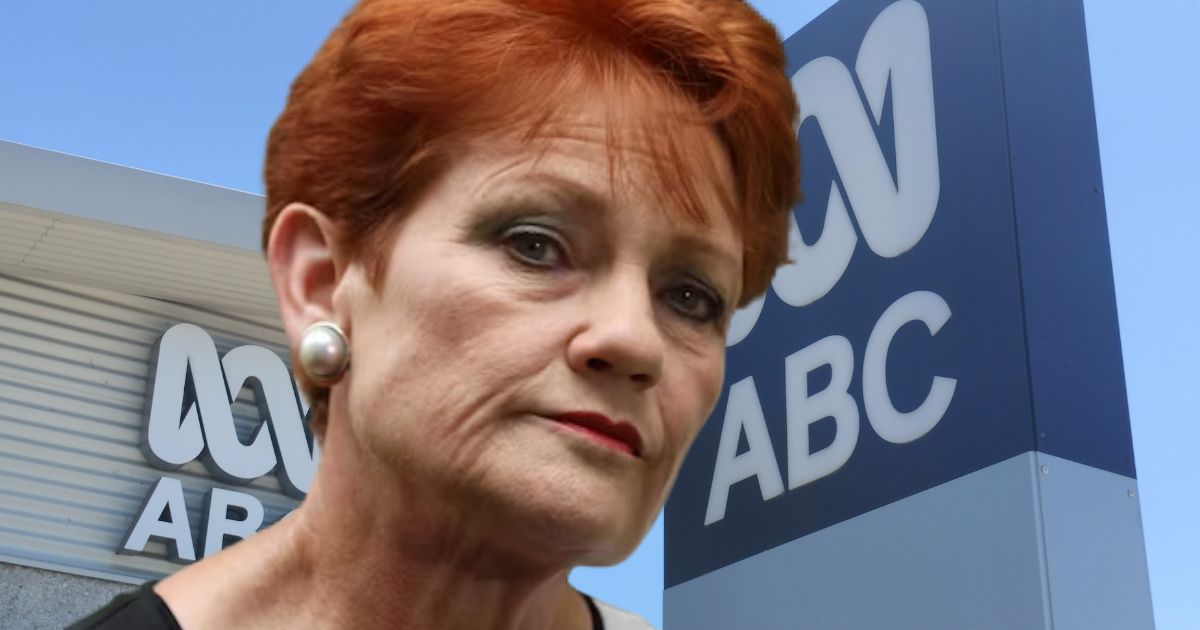
One Nation leader Pauline Hanson burst Trump-like into anger-infused prominence across all media at her first-ever address to the National Press Club on June 17. In front of a protest banner, she demanded a monocultural Australia, denounced high immigration levels, Islam, transgender rights and abortion, and very specifically vowed to destroy both public broadcasters. If One Nation wins the next federal election, she said, they would axe SBS and defund the ABC, making it available only to people who pay for it, except in high-need regional and rural Australia.
The surge in her party’s legitimacy as a political player started a month before, on May 9, when One Nation candidate David Farley won the federal seat of Farrer, the first One Nation candidate ever elected to the House of Representatives. The ABC was banned from attending One Nation’s election-eve press conference, and ABC journos were ejected from the event as other media just watched.
All of this may have been seen as the same old Pauline had it not been for a sudden meteoric rise in the polls. Two days before the Press Club address, One Nation led for a second straight week on primary vote in Roy Morgan polling, with the ALP still favoured to win the federal election. By June 22, Morgan polls found the federal election was now ‘too close to call’ as One Nation increased its primary vote again.
What happened? It’s out of the Trump playbook, according to Zoe Daniel, former ABC broadcaster for 27 years and Washington Bureau Chief (2016-2019) when Donald Trump reined. Daniel was speaking at an ABC Friends Southern Bayside panel discussion on July 26.
“You have similar sentiment in the population (Australia compared with Trump’s America) where broadly people are pissed off about something,” she said. “They think they’re not being led well. They believe that the wealth gap means that elite people are leading them and they’re not getting a say and no one really cares about them. Globalisation’s negatively affected them; immigration’s negatively affected them. Their children will have a worse life than they’ve had. We’ve seen both major parties on the skids. … And then One Nation pops up and says – Well, if you want to explode the system, we’ve been here for a while, but we can grow to fill that gap”
The surge in One Nation’s polling is not just voters being pissed off, according to Dr Denis Muller, Honorary Senior Research Fellow at Centre for Advancing Journalism at the University of Melbourne who shared the panel with Daniel.
“I worked with Irving Saulwick for about 20 years on the Age Poll so I’ve done quite a bit of public opinion polling,” Muller said. “When One Nation’s vote began to rocket up I began to think this is not an organic shift. This is not what happens. Public opinion shifts but doesn’t shift like a rocket into the sky. And so I began to wonder whether there were other forces at work”.
And there were. Again following the Trumpian playbook, it appears that the ‘oligarchs’ swept in to manage the media and the candidate. Australia’s richest person, mining billionaire ($40 billion) Gina Rinehart, ‘gifted Hanson a “sexy” new private plane, worth more than $1.5m, to use in the lead-up to the next federal election, as a group of her close associates donate another $2m to the reascendant One Nation party’. More explosive media coverage came when a smiling, glowed-up Rinehart presented Pauline Hanson with a large, orange tractor during a keynote at a summit sponsored by Hancock Prospecting
But perhaps more impact on Hanson’s new preeminence has come from the more familiar oligarchs – the tech bros of Meta, TikTok and other social media platforms. An investigation by ABC News Verify in March revealed that an artificial intelligence (AI) “surge” supporting Pauline Hanson’s One Nation party was in play partially manufactured by foreign bot networks. ABC News Verify identified 20 foreign-run Facebook pages operating from countries like Vietnam, Sri Lanka, and the Philippines. The posts use ‘a mix of AI-generated and genuine images combined with compelling but completely fake stories. They’ve attracted hundreds of thousands of likes, comments and shares — many from very real Australian voters who appear to believe the fake news they are being served.’ This artificially inflates the apparent popularity of the party and distorts online discourse
Crystal Abidin, a professor of internet studies at Curtin University who has researched digital creator economies in south-east Asia, told the Guardian that ‘for a lot of the south-east Asian meme factories, the politics are entirely divorced from the profit making. They are for hire…. to attract brand contracts and to grow followers and subscribers, or to personally profit via monetisation schemes offered by Meta, TikTok and other platforms.’
Daniel’s seen it before and offers a warning.
“I think what the main thing I learned from 27 years of journalism was that the crazier things get, the crazier they get. Particularly when it comes to politics in Southeast Asia, sub-Saharan Africa (her other ABC postings), and the States”, she said. “ You’re watching something play out thinking, “Wow, surely this can’t be happening.” And then it happens and then an even more weird thing happens. Kos Samaras would say that One Nation has topped out at about 30% of the vote, which is identical to where Trump’s cement base sits. He thinks it can’t grow much beyond that, but I think that’s dependent on other factors. I also wonder about people’s willingness for experimentation to say, like they did in the case of Trump, “Well, we’ll give disruption a go; we’ll try and explode the system once”. The thing is once you’ve done that, it’s really difficult to repair the damage as we’ve seen in the States”.
In the face of this frenzy, and the political debates about the vacuum left by the demise of the Coalition and the real nature of Australians’ political views, there has been a weird turnaround in the polls – One Nation is slipping.
Despite its win over Labor in Secret Harbour’s by-election in Western Australia on August 30, national support for One Nation is dropping. The latest Morgan poll conducted from August 24-30 shows One Nation falling 3.5% (to 23.5%), with ALP primary support up 2.5% (to 29.5%). This trend is mirrored by the latest Guardian Essential poll which records the national primary vote for Pauline Hanson’s party dropping five percentage points since May (from 28% to 23%).
An undisciplined and messy immigration debate may be partially the reason, but Matthew Ricketson, Professor of Communication at Deakin University, co-author of the new book “Getting Murdoched”, who shared the ABC Friends panel with Daniel and Muller, believes this is where good journalism comes in.
The media – including our ABC – is pivotal in examining what One Nation is really offering, according to Ricketson.
“I would both hope and encourage journalists to do their job, which is to actually scrutinise what Pauline Hanson and One Nation are doing,” he said. “First here in Victoria, because we’ve got an election in a few months’ time in this state, and secondly for the federal electoral environment. What are their policies? I just think they should be turning up at every single media conference and asking, “Well, what’s your policy on this, on that, on housing, on defence, on climate change, on whatever?” And just keep asking that question because they’re not answering it”.
Australia’s next federal election is not until 2028. There are no guarantees or roadmaps on what will happen to the intention of voters, One Nation or the ABC. The one sure factor is that AI and the monetisation of social media using it will continue to grow. Right now, pundits are saying that it’s right-wing, extremist and hate-based social media that’s earning more money for content creators and media platforms, and that much of the anger-based social media is manufactured. Political communications expert Ed Coper says “angertainment” is shaping society and there’s a high chance you have fallen victim to it, that these social media algorithms are designed to make us mad, and it’s impacting the way we communicate and vote.
Who’s going to control the cat now it’s out of the bag? And how do we, Australians who care for truth, peace, equity, humanity, education and our country’s history and culture, ensure we have the best institutional source of all of this, the ABC?