
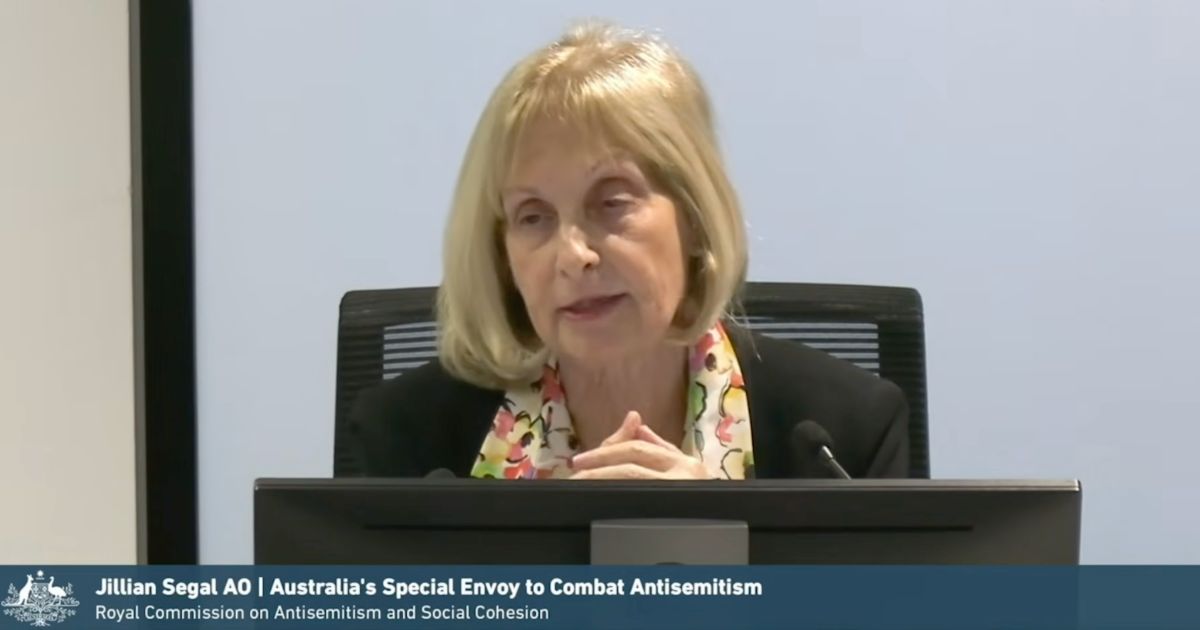
On 9 July, Jillian Segal, Australia’s Special Envoy to Combat Antisemitism, gave evidence to the Royal Commission into Antisemitism. Senior ABC and SBS editorial managers and the ombudsman also appeared.
In her testimony Ms Segal called for an external committee to oversee the ABC’s editorial coverage, specifically to ensure that it is not biased in its coverage of the Israel Gaza war. Alternatively, she suggested that an external ombudsman should oversee editorial coverage for both the ABC and SBS.
Despite Ms Segal’s statements to the contrary, the proposal for some sort of monitoring committee is a direct attack on the ABC’s independence and its ability to present the news without undue pressure from any external organisation or individual.
In one significant intervention, Commissioner Bell noted that the statutory structures and independent boards of the SBS and ABC are one way of creating independent entities that the public can trust.
Bell asked:
You envisage putting on top of that structure a committee of individuals including those who have a particular, as it were, bandwagon. How is it, in your view, consistent with promoting the trust in the ABC as independent if people know that there is a monitoring committee, whatever you want to call it, that has been selected to represent particular views?
Segal’s response was to suggest that the overarching committee need not include people from the Jewish community as long as it included people who are aware of and understand modern antisemitism. Perhaps the ABC could be overseen by a conglomeration of committees, each charged with subjecting the ABC to scrutiny on matters that are of interest to particular communities?
The notion is preposterous and should be rejected out of hand.

Read our submission
The Royal Commission on Anti-Semitism and Social Cohesion
by Cassandra Parkinson, National President, ABC Friends
Public policy needs more than flimsy evidence
Segal’s testimony was riddled with inaccuracies and vague statements. She referred to a “common and pervasive perception” of bias in the ABC’s coverage of the conflict among the Australian Jewish community and argued that the ABC’s reporting had created an “impression of great negativity about Israel”. But to blame journalists for reporting the actions of a nation state is to let that country off the hook.
In a forensic examination — one befitting a former Media Watch host — Jonathan Holmes rebutted the inaccuracies in Segal’s testimony. For example, she claimed incorrectly that the Australian Communications and Media Authority, ACMA, is not able to institute its own inquiries. She implied wrongly that the ABC ombudsman does not report publicly on the complaints that it upholds or does not uphold. And she seemed unaware that the ombudsman issues twice-yearly reports that detail the thousands of complaints the ABC receives.
As Holmes said:
There is no doubt that the rise of antisemitism in Australia is real, shocking and horrible. There is no doubt either that the current stage of a decades old series of conflicts and wars, a stage that began with Hamas’ attack on southern Israel in October 2023, has been a primary cause of that recent rise. But for Ms Segal to blame the ABC and SBS for this horror is simply to blame the messenger.
The testimonies to the Royal Commission highlighted the complexity and difficulties of this issue. ABC Friends itself receives significant amounts of correspondence from both pro-Palestinian and pro-Israeli supporters, each contending that the ABC’s coverage of the Middle East conflict is biased.
The ABC ombudsman told a similar story. She has received around 8,000 complaints about the ABC’s coverage of Israel and Gaza since October 2023, with some of those driven by organised campaigns. That there is such a volume of criticism from opposing sides does not resolve questions about editorial standards, but it does counsel against treating complaint numbers alone as evidence of systematic bias.
As the ombudsman said:
I think that the number of complaints that we are getting in these sorts of areas do reflect, to be perfectly honest, the perception of the complainant who isn’t seeing what they want or hearing what they want as the news cycle changes, or they haven’t seen what was on yesterday. And it’s often very emotional on both sides. And many of them as in the campaigns on both sides are definitely coming from interested parties. I’m not sure what that is supposed to achieve, because I will look at each individual complaint individually and determine what, if anything, is a concern. I just don’t know how much stake you can put in the numbers at all, to be perfectly honest.
The ombudsman gave a fascinating insight into the work of her office and is well worth reading.
The role of public interest journalism
The issue goes beyond the ABC and SBS. It is about allowing journalists to witness, record and report facts, about giving them space to report fearlessly and honestly.
Of course, the ABC and SBS make mistakes — all newsrooms do. What matters is how they address mistakes and what measures they take to avoid them in the future. As the ABC ombudsman’s testimony demonstrated, this is precisely what happens at the ABC if complaints about bias or poor reporting are upheld.
The rise of antisemitism in Australia and around the world is deeply disturbing, and it must be taken seriously. But the answer is not to impose an external body to police the media.
This smacks of what happens in authoritarian regimes — and what we are seeing in Donald Trump’s America, where the Associated Press was denied access to White House briefings because it dared to suggest that Trump’s renamed Gulf of America is actually called the Gulf of Mexico; where individual journalists are belittled if they’re not “nice” or don’t smile; and where Trump warned the ABC’s John Lyons he was “hurting Australia” by asking about Trump’s business activities.
Protecting the ABC’s and SBS’ editorial independence is not about avoiding criticism. It’s about protecting the public’s right to know.